Mothering Sunday 2021

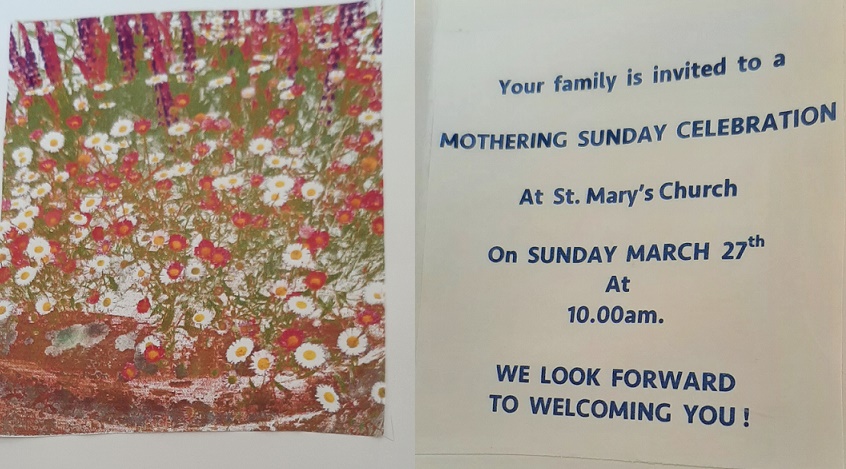
Well, we are now back where we began last year at the eve of Mothering Sunday the day in the Church calendar when we traditionally remember Mothers in all their glorious and sometimes not so glorious image. The time when groups should be meeting up to prepare bunches of glorious spring flowers and yellow trumpet daffodils to give out in Church and to those women unable to attend. A touch of festiveness in the middle of Lent, taken from us, almost one could say depriving us, separating us, creating a loneliness, bereft maybe of the touch or hug of loved ones, if we had been told as we entered the first lockdown that we would still be here in a year, how I wonder would that have affected us differently, as for sure it would have done. A long journey of faith and fear, joy and sadness, loneliness and new friendships. Rev Katharine was still here with us celebrating alongside Rev Ann, it seems such a long time ago. Mothering Sunday the day when we identify with Mother God as well as Father God

Introduction Over 100 years of Mothering Sunday
In 1913 Constance Penswick-Smith (1878-1938), the daughter of the vicar of Coddington, Nottinghamshire, caught the vision to celebrate Mothering Sunday. Later in 1921 Constance wrote a booklet asking for a full revival of Mothering Sunday, eventually founding The Society for the Observance of Mothering Sunday and spending more than 25 years promoting the celebration of the festival. Thanks mainly to Constance’s efforts, Mothering Sunday – which has its roots in the pre- Reformation Church – has been widely observed and re-established across the Church of England, and celebrated in wider society. There are traditions associated with Mothering Sunday in England which date back as long ago as the 16th century. It is told that this was the day when people were encouraged to return to worship in their ‘mother church where they had been baptised. People who usually attended the local parish church, would make a longer journey to the ‘mother church’ or cathedral of the Diocese. Girls in domestic service would bake to show their mothers their new skills in the form of a gift, traditionally a simnel cake. On this day many girls who were in service were allowed time off from domestic chores to visit their mothers and their family.
Today Mothering Sunday is a popular day when Christians choose to use the occasion to think about all things which concern motherhood, in all it’s different forms and ways. We give thanks for the Church as Mother, the Virgin Mary as the mother of Jesus, we remember that God cares for us like a mother and last but not least we give thanks for our own mothers or those who loved us and brought us up as our mother. Mothering Sunday is is a time of special thanksgiving. It is the one day of joy in Lent, when flowers abound in all churches and when people are allowed a time off from the penitential season. It is also known as Mid-Lent Sunday, Refreshment Sunday or Laetare Sunday. The Latin name of Laetare, means rejoice.

In the fourteenth century Julian of Norwich, the first woman to write in modern English, experienced and understood the motherhood of God in her visions. Mothering Sunday is a good day to share her vision and recognise that although we are distinguished by our gender, God is not. Instead God is both mother and father to us.
‘As truly as God is Father, so just as truly is he our mother.’ Julian of Norwich. Adapted from “this is Church”

For me Mothering Sunday this year strangely enables me to identify more closely with those who have lost or never had a good mother experience, or the ability and desire to be a mother. I believe that is the case for many of us. I don’t own those experiences I have my own mother who I love, but have not seen for over a year now, but the lose of seeing and being has created a vacuum which is going to continue for this year. It will be extremely hard this year I believe to give, or be, how we would otherwise be, there will I am sure be a rawness about this year’s Day. There will be the lamentation of loss, which is mirrored so deeply in our Gospel reading for us.


That moment in time when Mother Mary, her sister and the two other Mary’s were gathered at the Cross. The fact that they were even there should not be lost on us alongside the lamentation of loss for Jesus as he gave his loving mother Mary over into the care of his beloved Disciple John. Mary is not just a mother, she is a Jewish one mother, she knows that her role is not only to be a loving mother for her children, but also their teacher. In the Gospel John the evangelist places the disciple standing by the mother, his testimony accompanies Mary’s testimony. She is also a disciple that follows her Son to the cross. She is giving her spiritual sons and daughters the example of a firm witness who follows the Master’s footsteps, even as in her heart surely she remembered the words of Simeon, “and a sword shall pierce your heart”.
Let’s hold the joy and sorrow, lamentation and vision of the new earth and new heaven together in a bobbly ball in our hands and hearts, living in the knowledge that despite what emotions and thoughts rise within us we are held by Mother God through the Spirit.

Revd Georgina Vye

Third Sunday of Lent

A Service for the Third Sunday in Lent

Dear Friends

‘For the foolishness of God is wiser than human wisdom, and the weakness of God is stronger than human strength.’

 The passage from 1 Corinthians which is one of our readings today is one of immense power and also one that speaks to the unique quality of Christianity.

I was listening to a fascinating history programme this week, concerning the Egyptian Pharaoh, Akhenaten.  At some point during his reign as Pharaoh he declared that the god, Aten, was the only god, moving away from the centuries old practice of worshipping multiple gods.  He had temples and palaces built to Aten and took the name Akhenaten, meaning ‘the spirit of Aten’.

His vision of the only god was of one of great power who demanded worship and absolute obedience.  Aten was, for Akhenaten, a supreme leader and being.

All through history gods have been feared and worshipped and sacrifices made to them, but Christianity is unique among religions because we believe that God loved humanity so much that he himself became the ultimate sacrifice on the cross.

I personally believe that Christianity is good for our emotional and spiritual well-being because God, in Jesus, completely experienced our brokenness and entered into it so that he might mend us.  He became weak on behalf of all our weaknesses and took upon himself all of our willful wrongdoing.

This may well be looked upon as weak and foolish by many.  But, of course, the story doesn’t end there.  What looks like God’s folly and weakness in Jesus’ death on the cross, is transformed into something else completely through the resurrection.  Through the lens of the resurrection the crucifixion does not look like weakness at all, but the way to freedom and new life.

So, our own weakness and brokenness is no longer the end of the story because God himself has taken it all upon himself and offers back to us the chance of forgiveness and transformation. That does not sound like foolishness, but the ultimate wisdom, full of grace and mercy.

I enclose with this letter, a letter from June Foster which makes for a fascinating and moving read.  The young people she describes, joyfully worshipping God in places where they put themselves in danger, may be accused by some of foolishness.  But they have the experience and belief in God’s transforming power and strength and that, in my book, makes them very wise indeed.

Every blessing

Ann


A letter from June

Dear Friends

the world

“For several decades a spiritual awakening among Algeria’s Berber or Amazigh people has been producing the fastest-growing Christian community in the Arabic-speaking region.  Since the network’s first broadcasts in 1996, SAT-7 has resourced this vibrant Church, initially with our Arabic programmes and, since 2012, with broadcasts in the Berber Kabyle dialect.”

This is a quotation from Sat-7’s magazine published a year ago.  

SAT-7 is a UK based charity dedicated to growing Church in the Middle East and North Africa, serving the community, and contributing to the good of society and culture.

Their aim is to provide the churches and Christians of the Middle East and North Africa (MENA) an opportunity to witness to Jesus Christ through inspirational, informative, and educational television services.

Algeria was one of the places I visited on Wednesday 10th February 2021, via Zoom and courtesy of SAT-7.  The Protestant Church of Algeria was first registered in 1974 but had to wait till 2011 for legal recognition.  Then in 2017 the gradual closure of churches began – despite freedom of religion guaranteed by Algeria’s constitution.  This movement to close churches continues. On Wednesday, George Makeen, Programming Manager spoke of the church being strong and growing but much in need of support.

Leaving Algeria I moved on to Lebanon and to Beirut in particular.   Lebanon has been at peace for 30 years, but economic mismanagement and mass protests have put its creaking political system under greater pressure than at any time since the civil war. This is an area I have been interested in for a long time.  It is now just six months since the terrible explosion close to the port.  The SAT-7 office and broadcasting centre was situated near the site of the explosion. Fortunately none of the staff were injured, but they were out quickly, serving food to rescue workers.  The city has been badly hit by the Covid 19 pandemic.  Citizens are being taken to hospital by frantic relatives trying to save lives.  Many are dying in their cars before being admitted to hospital and hospitals have run out of oxygen, yet oxygen is available on the black market!

Next to Iran and the story of Dani a young man who loved and worshipped God through his Muslim faith.  He was a serious and honourable young man, but, like many young people, he began to question his faith.  He felt there was something missing. So he tried various other routes to worship but remained dissatisfied.  His Mother, concerned for her son, placed a book on the table for him to consider.  The book was a copy of the New Testament.  Through an interpreter, he talked about how his life was changed.   He has trained to take on leadership roles and is working towards assisting other young people to find their way through Christ.

This was quite a visit to the Middle East and left me with many troublesome thoughts. But the most important thing I remember is the amazing joyfulness evident in the lives of these young people, and I would emphasise YOUNG.   Despite all the hardships they suffer every day of their lives, their love for and worship of Jesus is so real.  They were indeed “lights of the world”.

It made me question why, in this country where worshipping God is so easy, requires no effort and certainly no risk to life, is there no joyfulness.   Yes, we are saddened by the closure of Churches, but even when they are open, I do not detect the sort of joyful, light giving pleasure and thankfulness seen among those for whom worship is a risk to life and limb.

We talk of “returning to normal” when we are again free from current restrictions.  But I am not sure I want to return to “normal” as before.  I want to be part of a Christian community which expresses, through daily activities, the light of Christ in a darkened world.  And to show the joyful character of those whose lives are changed.


June Foster

A note from Tom

Since beginning my role in September as a youth pioneer in Chard, my role has been focused on understanding what life is like for young people growing up and living in the area, and how this could shape how the church engages with young people in their own contexts. One key aspect of this process has been coming alongside existing youth work projects within Chard, supporting their work and at the same time getting to know young people in the area. This has been a great experience, and I feel that a lot of important relationship building has been able to happen as a result.

 The next step is to look at how the church can step out in a project of its own to engage with young people and explore what Christian community might look like in a different way. I believe that the first part of this will be to deliver detached youth work in Chard, something that has been missing in the community for the past few years. Detached youth work is when we spend time with young people in the places they like to hang out in. There is no set activity or structure to the sessions, but rather opportunities to have conversations with young people, listen to their stories and be a positive presence for the time we are there, building relationships with young people on their own terms.

The aim is for there to be a team of volunteers who have been trained and ready to deliver this detached work in September. This means that between now and summer, the focus of the pioneer work will be towards building a team, praying together, and making sure that all necessary training and safeguarding checks are in place. The hope is that this project will be something that all churches in Chard can be a part of, and that together we will see God transforming lives and spaces in the community in powerful ways. There is plenty of space to come on board, and if you would like to be involved in some way then it would be great to have a chat about what that could look like. I’m certainly very excited about what God will be doing in young people’s lives and am looking forward to seeing where He takes us on this journey together.

I am also providing training and support for similar work in Ilminster and hope, soon, to be able to meet with members of churches in the villages who would like to undertake some outreach to their young people.

It goes without saying that I would appreciate your prayers for our young people, for the coming together of a team of volunteers and for where God will be leading us in the coming year.

Tom Tame

Chard Youth Pioneer

Second Sunday of Lent

Dear All

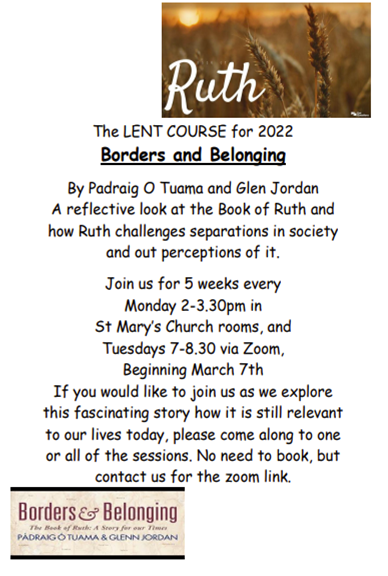
On Monday, we held the first session of our Zoom Lent course.  The reading we looked at is from Exodus Chapter 3:

Now Moses was tending the flock of Jethro his father-in-law, the priest of Midian, and he led the flock to the far side of the wilderness and came to Horeb, the mountain of God. There the angel of the Lord appeared to him in flames of fire from within a bush. Moses saw that though the bush was on fire it did not burn up. So Moses thought, “I will go over and see this strange sight—why the bush does not burn up.”

When the Lord saw that he had gone over to look, God called to him from within the bush, “Moses! Moses!”

And Moses said, “Here I am.”

“Do not come any closer,” God said. “Take off your sandals, for the place where you are standing is holy ground.” Then he said, “I am the God of your father, the God of Abraham, the God of Isaac and the God of Jacob.” At this, Moses hid his face, because he was afraid to look at God.

The Lord said, “I have indeed seen the misery of my people in Egypt. I have heard them crying out because of their slave drivers, and I am concerned about their suffering. So I have come down to rescue them from the hand of the Egyptians and to bring them up out of that land into a good and spacious land, a land flowing with milk and honey—the home of the Canaanites, Hittites, Amorites, Perizzites, Hivites and Jebusites. And now the cry of the Israelites has reached me, and I have seen the way the Egyptians are oppressing them. So now, go. I am sending you to Pharaoh to bring my people the Israelites out of Egypt.”

But Moses said to God, “Who am I that I should go to Pharaoh and bring the Israelites out of Egypt?”

And God said, “I will be with you. And this will be the sign to you that it is I who have sent you: When you have brought the people out of Egypt, you will worship God on this mountain.”

 This is one of my favourite readings from the Old Testament.  Here we learn a great deal about the nature of God and his love for his people.

But we also learn that when God called Moses he did not leave him to carry out His will on his own.  Firstly, God promises Moses that he will never be on his own.  Later, God also sends Aaron to help Moses, to be his ‘voice’. 

God calls us to do His work here on earth, but He will never leave us unequipped.  Firstly, he is always with us, through thick and thin, when the going is easy and, most especially when the going gets tough.  However, he will also provide us with what we need for the task, in the shape of others to support, care and pray for us.

Whilst I was training for ministry, my father and best friend both died.  They had been two of my greatest supporters and sources of encouragement.  I wondered if I would get through the rest of the training, but shortly after my father died, we had a new associate minister arrive at my church from Texas.  He was, and remains, a wonderful mentor and friend and he came just as I was wavering and full of fear.  God did not leave me alone but equipped me to carry on.

Secondly, God calls Moses while he is out tending his flock, something he did every day.  We may not see a burning bush, but God most often calls us through the everyday, the commonplace and the familiar.  Some people are called, like Moses, to completely change their lives, to take risks and put themselves in challenging places.  Others have quieter callings, to be the light of Christ where they are, in their community, among their friends and family.

Whatever our own calling and response to God, one thing is sure.  That we never know when we are standing on holy ground.  Even in the ordinariness of our lives, we never know when we are going to encounter God and what he might be calling us to do.  I am always reminded of one of the last lines of one of my favourite books by J D Salinger: “Seymour once said that all we do our whole lives is go from one little piece of Holy Ground to the next”.

With this letter is a newsletter from Tom Tame, our Youth Pioneer, working in Chard and around the Deanery.  Tom answered God’s call to move to Somerset and take up this work, trusting that God would not leave him on his own.  He is already equipping himself by building up a team of volunteers to go out and meet with youngsters where they congregate.  Tom is supported by the Diocese and through networks of other pioneers.  He is now asking for our support by asking us to pray for him.   I hope that you will do this as he sets out on this exciting venture and pray that he will find holy ground in many different places.

At the end of our Lent course, we were asked to take the following prayer from the Book of Numbers and say it quietly or silently for some of the people we talk to or pass by, for homes of people we know and for schools, offices, shops and farms we may pass on our walks.  We might also say it for people or situations that we see on our TVs or hear about on our radios:

“The Lord bless you and keep you;

the Lord make his face shine on you and be gracious to you;

the Lord turn his face towards you and give you peace.”   (Numbers 6: 24-26)

A simple prayer, but if we were all to be silently saying this for others, think how powerful that would be.

Every blessing

Ann