Category Archives: Parish News

Sunday Before Lent

Dear Friends

Have you ever said anything on the spur of the moment, then deeply regretted it afterwards?  I know I have….

In today’s Gospel reading Peter, along with James and John, witnesses Jesus’ transfiguration and blurts out that he and the others should set up three shelters, one for Jesus, one for Moses and one for Elijah.  Then we have the statement in brackets, “He did not know what to say, they were so frightened”.

What must have been going through Peter’s mind?  What could he have made of this revelation of Jesus’ glory as the Christ? 

Peter is someone who we can identify with so strongly in the gospels because he so often gets it wrong.  I doubt we would have done better. 

Peter’s instinct is to preserve the moment for ever, to keep Jesus in his blazing white and Moses and Elijah with him in shelters.  It was in some ways a very natural reaction.  When something wonderful happens to us, we feel like we want to preserve it for ever and, of course, we have the means at our disposal in photographs, videos and on our computers. 

Peter, however, by wanting to keep the transfigured Jesus in a shelter, has completely misunderstood the meaning of the transfiguration.

The story of the transfiguration comes in Chapter 9 of Mark’s Gospel.  This is at the half-way point of the gospel and marks the transition from Jesus’s early ministry to his journey to Jerusalem, his death and resurrection.  From this point in Mark’s gospel Jesus is travelling to Jerusalem and his inevitable death on the cross.

The transfiguration is Jesus showing his most trusted disciples his true nature as part of the Godhead. He then tells them not to tell anyone what they have seen until after ‘the Son of Man is risen from the dead’.  The disciples do not understand what this means and later in the same chapter when Jesus again foretells his death, the disciples again fail to understand.

Peter wants to preserve Jesus in his glory but, along with the other disciples, does not understand Jesus’ predictions of his suffering and death.  This is not how things were meant to turn out.  How can someone who has revealed himself as divine, someone who claims to be the Messiah, now be speaking of his physical suffering and death?

This is a turning point in Mark’s gospel, and it takes the disciples the whole of the rest of the gospel to understand what it is that Jesus is telling them.

We too are standing at a turning point, both in terms of the church year and also in what is happening in our collective lives.

Having just celebrated the end of the Epiphany season, next week we enter Lent and for forty days we travel to the cross with Jesus. We are also, it seems, at a turning point in the fight against the Coronavirus, as more and more people receive the vaccine and politicians begin to speak tentatively about a ‘roadmap’ out of lockdown.

We have been celebrating Jesus as the light of the world, and now through Lent we will see him as the suffering servant.  Before we do, however,  today we are reminded of Jesus’ glory and majesty.  For Jesus is both things.  He is both part of the divine Godhead, and also the one who has to suffer and die for our sakes.  This is the point on which our faith pivots.  God, who is pure divinity, becoming fully human so that he may take on himself all of our pain, all of our brokenness, all of our wilful wrongdoing.

Jesus in his glory cannot be contained in any shelter that Peter could construct.  He has to go through his passion and resurrection on our behalf and because of that he becomes the universal Christ – the glory and majesty of God that cannot be contained.  His mercy, justice and peace is now out in the world and cannot be limited.

So, why do we, so often, try and contain Christ?  Why do we try and limit what God, through Christ, can do?  At times, we want to keep him at a distance, keep him only for Sundays.  We fail  to see him in the faces of others, particularly those who are different from us. We shy away from talking about him out of embarrassment or fear of ridicule.

Would we, like Peter, prefer a contained Jesus, safely in his shelter and not really bothering us.  However, as Peter learns this is not how it works.  For Peter, the disciple, who so often gets it wrong, on the day of Pentecost, is transformed into one of the first great Apostles, telling the good news of Jesus Christ and dying for his faith.

This Lent, in whatever way we can, let us consider how we can open ourselves up more to the call of Jesus to follow him.  We don’t have to make grand gestures or change our lives dramatically, but we do have to pay attention to our attitudes and behaviour towards others, to the way we live, and how we might show in these two things the limitless mercy, grace, and love of God, shown to us in Jesus Christ.

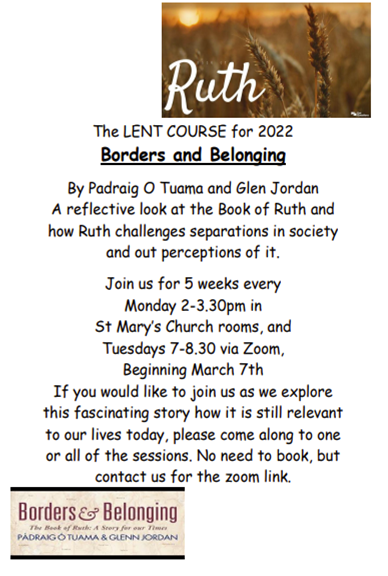
This Wednesday is Ash Wednesday, and we will be holding Morning Prayer at 9.30 am and a service at 2.00 pm. We will be running a Lent Course which will take place at 10.30 am each Monday in Lent, beginning on Monday 22nd February.  If there are any of you who would prefer an evening for the Lent course please let either myself or Georgina know and, if we have enough people, we will run the course on Monday evenings.

All these events will be happening via Zoom and you will be sent the invitations well in advance.

Every blessing


Ann

2nd Sunday Before Lent

Sunday Sheet

Dear Friends

On Tuesday we celebrated the Feast of Candlemas which officially marked the end of Epiphany, and as you will see at the top of this letter, we are moving rapidly towards Lent.  I read something this week that said at Candlemas we turn from the cradle to the cross.  But before we do, we have two Sundays when we are reminded of who Jesus was and who he is.  This week we have the reading from the beginning of John’s Gospel, which we would traditionally read at Christmas.  However, it is always worth revisiting this beautiful passage and here we are reminded that John’s Gospel begins, not at Jesus’ conception or in the cradle, but at the birth of the whole cosmos.

No angels, swaddling clothes, or sheep enter the scene to turn our attention from the essential point: God, through whom the world was created, the one who gives light to all people, became a human being. God lived among us and died among us. In this one human being, out of all the billions who have lived, God’s own glory shone with life-giving light.

John’s statement, “the Word was with God, and the Word was God” is telling us that Jesus is God’s word and that he is God’s self-expression, God’s thought, or mind.  He is the word of God spoken out loud. Jesus doesn’t represent God, he is God.

John describes Jesus as the Word (logos in Greek) and connects us with the story of the creation in Genesis.  He tells us that the created order depends on the Word, without whom not even one thing has come into being.

So if this is so, then does this mean that if all people are created by God, aren’t all people God’s children? Well, yes, but not all children reflect well on their parents. Ideally, the apple doesn’t fall far from the tree. True children of God put God’s love into action.  And we do this because we have the example of Jesus.

John’s language is striking. God’s Word becomes not just an idea, a belief, or a myth, it is not just a spiritual reality, but flesh. Jesus’ flesh is a reality that means we as fleshly beings are made holy by him.

Throughout history some strains of Christianity have emphasised the spiritual realm at the expense of the material world. Many Christian leaders have dismissed earthly life and the body itself as unimportant, distracting, or even dangerous. This passage, and the whole Gospel of John contradicts this. The Gospel writer stresses that God chose to live a human life in a human body. That body—Jesus’ flesh—is not just God’s side-line, and can’t be denied, or dismissed. It becomes the place of God’s revelation.

The prologue to John makes it clear that God created and loves this material world and the material beings who live in it, and that God took on material form in order to redeem it and us.

God became incarnate in Jesus and made the whole of creation holy. So we too must see the whole of creation as holy. This may not be so easy to see at the moment as we mark 100,000 deaths from Covid in the UK and see no end to this current lockdown.

But we can be confident that anything that we experience, anything that happens to us individually, as a community, nation, or currently as a whole species, is not insignificant to God.  We have been loved enough for God to become one of us so that we don’t have to go through anything alone, even the very worst of times.

We have seen much good coming out of the last year and much that has surprised and delighted us as well as much that has scared, disappointed, and grieved us.

Mick and I are huge fans of the TV series, The Repair Shop.  In it incredibly skilled craftspeople fix and mend people’s treasured possessions usually items that have real emotional value and that have been passed down through families. I find this is so comforting to watch because we see people with huge skill, being entrusted with people’s damaged and worn out treasures and mending them.  It reminds me constantly that nothing is too broken that it can’t be fixed, and this includes people.  I know this because God, in Jesus, became a person himself – a real flesh and blood person. 

And as we turn towards Lent and then Easter, we know that Jesus not only became a flesh and blood person, but suffered and died in order to fix us, all of us.  So we are called not to entrust our treasured possessions but to entrust ourselves to Christ, and we can do this with confidence because we know that he has experienced what we experience.  He has taken our human, material lives and through his death and resurrection offered up all of our brokenness and given us back the way in which we can be mended and made whole.

Just like watching The Repair Shop, I find so much comfort in this. I can honestly say that although I may not always recognise it or see it, God is working through his creation all the time, and because of what Jesus did, God is working through us too.

Through Jesus, our ordinary human lives can become places where God’s glory shines. The Word became flesh to bring us all into God’s family. The Word became flesh to help us see every human life as being holy in God’s eyes.  Let us pray that, even in these unprecedented times, we may see this too.

Every blessing

Ann


Candlemas

Candlemas the Festival of light when we traditionally bless the candles for use in our Churches, and many are discovering that this is the end of Christmas and the decorations can be left up until now. This Feast of Candlemas can be traced back to at least 543. The Feast of Lighted candles is mentioned by Bede and St. Eligius, who was Bishop of Noyon from 640 to 648. It is celebrated on either the nearest Sunday to 2 February or the day itself and it marks the purification, under Jewish religious law, of the mother of Christ 40 days after his birth; it also commemorates the presentation of the infant Christ in the Temple.

Our Gospel reading for today talks of the light coming into the darkness of the world, it depicts Simeon, old and well-aged coming to the end of his life, but holding on to that promise he has been given by God, you will see the Lord’s Messiah before you die. He must have been wondering, when oh when, will I see the Lord? And then in that moment that will always hold such beauty and mystery and the completion of God’s promise, Mary hands Simeon Jesus. We can’t know how that felt, that moment, amidst what would be the hustle and bustle and noise of the Temple life the new meets the old, the generations are held together in Simeons hands, and the story of God continues. And Anna comes up and recognises the Messiah, she begins to tell those around her, “Here he is, amongst us”, Who stopped and listened? Who thought, silly old woman? Who caught the moment, heard the words, saw the fulfilment on their faces?  Imagine yourself in the moment too, take some time to sit and read the story and picture in your mind, how each would have received and participated, ask God to reveal to you in your inner being, something for you to hold and treasure, in these moments of our waiting.

It wasn’t all joy, of course. Mary left with those words of Simeon in her heart. ‘This child is destined for the falling and the rising of many in Israel, and to be a sign that will be opposed so that the inner thoughts of many will be revealed – and a sword will pierce your own soul too. When they had finished everything required by the law of the Lord, they returned to Galilee, to their own town of Nazareth. The child grew and became strong, filled with wisdom; and the favour of God was upon him. So much encapsulated in the journey and time in the Temple.

Lastly, we are minded that this is also Snowdrop Sunday, another source of brightness also closely associated with Candlemas. Candlemas bells they were once called, and it is easy to see how they were the perfect flowers for the feast – flawless symbols of purity, so perfect. It is not hard to imagine what pleasure must have been taken in gathering them, or in merely having them growing by the church, on the day itself. And even today many of our best snowdrop displays are associated with the old faith, clustering around churchyards and ancient religious foundations, ruined abbeys and priories, where they were planted with Candlemas in mind. Combe Church has such a beautiful display along the banks. Apart from their pure beauty, the timing of their appearing as they do when the earth is still under the lock and key of winter. They’re the very first sign of something else, the Candlemas bells, are an undeniable signal that the warm days will come again; and I delight to see them in the banks and hedgerows in the parishes when I need to travel around. Little white heads popping up against the dead tones of the winter earth, is Hope, and Life suddenly and unmistakably manifest in white. Light and hope in the midst of your darkness be with you in God’s holding and Blessing. 

Rev Georgina

Candlemas Services

Thanks to all who joined us for our Zoom service this morning, which was really lovely.  Thanks to Georgina for putting it together and to the Fareys for singing so beautifully.

Below is the link to the recording of the service for those who couldn’t join us.  You will need to put in the passcode to access it.

https://us02web.zoom.us/rec/share/mVgrFGulF-r_j-gPzKwKNg4wR0jJGc1JLmqW6zY4qOg5WukxFZCwKO8wZfq43oEY.cdi_XAn8ZWePrEQi Passcode: .D9b$H50

In the meantime, here is a link to a lovely reflection and prayers for Candlemas from retired bishop Trevor Willmott which is on the Bath and Wells Website.

https://www.bathandwells.org.uk/2021/01/bearing-the-light-of-christ-bishop-trevor-willmott-shares-a-reflection-for-sunday-31-january/

Sunday Sheet – Candlemas

Letter for January 31st, 2021